






In a Roundabout Way…
By Tom Seest
At Dunlap Directory, we help Dunlap, Tennessee, business tell stories and market and sell their products and services.
NOTE: Special thanks to Mike Maddalena and the Sequatchie Post for his ongoing coverage of this controversial story, and for declaring it dead, and soon forgotten. Also, special thanks to Dwain Land for representing the community of Dunlap, Tennessee, and advocating for the needs of the community.
🎤 Music Video
🎤 Audio Overview
🎤 Song For This Story
They Killed the Peanut Roundabout
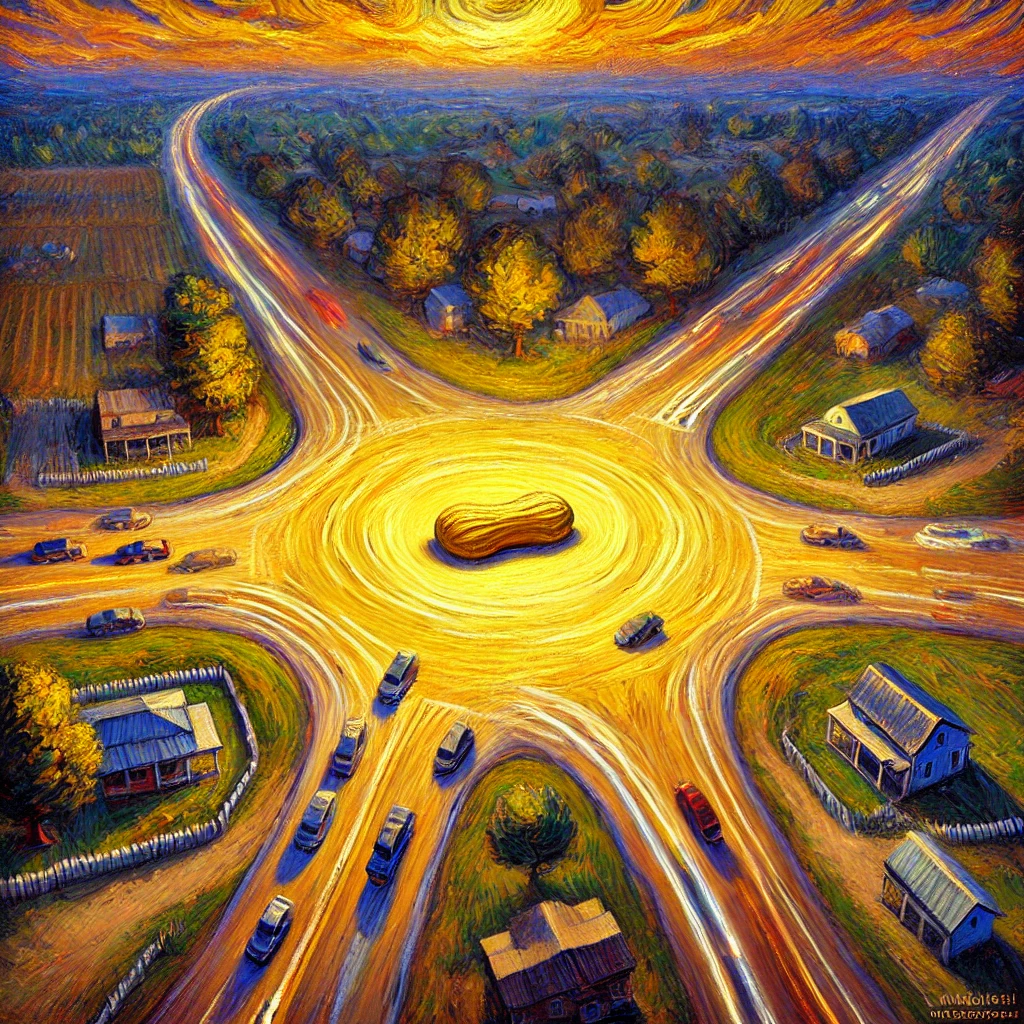
In every town, there are places that almost hold memories—places that could have brought people together, if only they had ever been built. The Peanut Roundabout was more than just a proposed traffic circle adorned with a giant peanut statue; it was the heart of a community that never quite had the chance to form around it. Here, friendships might have blossomed, and generations of families could have gathered, telling tales over melting ice cream cones while laughter echoed around a monument that existed mostly in imagination and mild panic. When they announced its quiet removal from the plans, it felt like losing a dear friend we never met; an anchor point that never quite anchored anything except a spirited debate.
On any given Saturday, that is, in the version of events that never happened; you could have found grandpas whittling wood on benches that were never installed, kids racing their bicycles around a peanut that never towered, and local artists setting up easels to capture a charm that remained safely theoretical. It was not just a roundabout; it was a stage for life that never opened, where people of all walks might have found common ground, united by the shared confusion of yielding properly while circling a legume.
Rationally speaking, you might say, “It was never built.” And technically, that would be correct. But the Peanut Roundabout was already a part of our narrative; the kind of story people tell with great conviction about something they were absolutely certain would go terribly wrong. Removing it wasn’t just about improving traffic flow; it was about erasing entire chapters of hypothetical inconvenience, missed exits, and deeply concerned conversations at the diner. It’s about more than efficiency. It’s about the moments we almost had—the arguments we rehearsed, the fears we nurtured, the directions we were never quite sure how to give.
Ethically, we ought to ask ourselves: who benefits from the removal of something that never existed? The planners and engineers might say it’s about safety and access, but at what cost to the rich tapestry of imagined chaos we had already begun to weave? When big decisions are made to prevent future confusion, we must consider the present loss of storytelling potential. Our town deserved the chance to be mildly bewildered together.
Let’s not forget the authority that lies in community; especially a community united in preemptively resisting something it hasn’t yet experienced. When we come together, our voices become a powerful force, capable of stopping even the most hypothetical of peanuts. If generations before us could stand up for what might have been confusing, then we too can rally against the possibility of learning something new.
As time moves on, we may feel the absence of the Peanut Roundabout—not in our roads, but in our conversations. There will always be a quiet space where it could have been, a circular void in both pavement and potential. But our shared memories; carefully constructed from speculation, concern, and a firm commitment to avoiding rotational traffic, will forever bind us. Let’s carry that spirit forward and ensure our future spaces remain firmly grounded in what we already understand, just the way we like it.
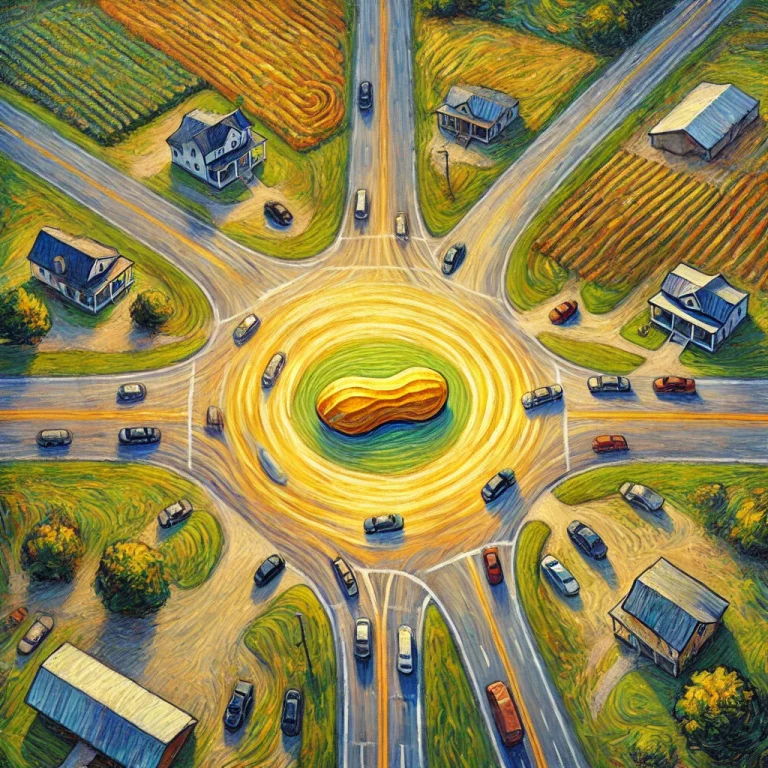
They Killed the Peanut Roundabout – Highway 28 Vision
In every town, there are spots that hold memories and bring people together—or at least, spots that were fully prepared to do so if given the chance. The Peanut Roundabout could have been more than just a quirky traffic circle adorned with a giant peanut statue; it stood on the brink of becoming the heart of our community, right up until it was thoughtfully prevented from ever trying. Here, friendships might have blossomed, and generations of families could have gathered, sharing tales over ice cream cones while laughter echoed through an intersection that remained stubbornly ordinary. When they announced its removal, it felt like the community was losing a dear friend we had already begun remembering fondly, despite never having been properly introduced.
On any given Saturday, in the version of Dunlap that lived briefly and vividly in our collective imagination; you could have found grandpas whittling wood on benches that were never installed, kids racing their bicycles around a peanut that never rose, and local artists setting up easels to capture a charm that never had the decency to materialize. It was not just a roundabout; it was a stage for life that never opened, where people of all walks might have found common ground, united by the shared experience of cautiously entering and confidently misunderstanding a circular traffic pattern.
Rationally speaking, you might say, “It’s just a traffic circle that never existed.” And yes, on paper, that holds up. But the Peanut Roundabout had already secured its place in our narrative; a symbol of resilience, character, and our unwavering ability to form strong opinions about infrastructure we haven’t yet encountered. Removing it wasn’t just about improving traffic flow; it felt like erasing chapters from a story we had already started telling, complete with missed turns, hesitant drivers, and vigorous diner debates about who had the right of way. It’s about more than efficiency. It’s about the moments we pre-lived so convincingly they became part of us.
Ethically, we ought to ask ourselves: who benefits from such decisions? The planners and engineers might call it practicality, but at what cost to the rich, imagined tapestry of confusion and adaptation we were fully prepared to experience together? When decisions are made to spare us from potential inconvenience, we must consider the loss of opportunity; to grow, to learn, to collectively hesitate at an unfamiliar yield sign. Our town deserved at least the chance to be briefly uncertain in unison.
Let’s not forget the authority that lies in community; especially a community united in preventing what it confidently believed would be a problem. When we unite, our voices become a powerful force, capable of halting even the most conceptual of peanuts. If generations before us could stand up for what mattered—particularly things they were fairly certain they wouldn’t enjoy—then we too can rally for the preservation of the familiar, however linear it may be.
As time moves on, we may feel the void that the Peanut Roundabout leaves behind; not in our streets, but in our stories. There will always be a quiet, untroubled intersection where something far more memorable almost happened. But our shared memories, carefully constructed from anticipation, concern, and a firm resistance to rotational progress; will forever bind us. Let’s channel that spirit of camaraderie and ensure our future spaces remain comfortably within the bounds of what we already know, grounded in the values of connection, tradition, and a well-maintained hesitation toward anything that curves unexpectedly.

They Killed the Peanut Roundabout – Highway 28 Vision – Reflection Scene – Holding Onto the Idea
Conclusion
The Peanut Roundabout stood as more than just a quirky traffic feature; it stood as the lifeblood of a community that never quite had the chance to gather around it. It was a cherished meeting place that lived fully in anticipation, where connections were already forming in theory, and memories were being fondly recalled before they had the courtesy to occur. Under the watchful gaze of a giant peanut that never rose, laughter echoed convincingly enough in our minds to feel almost real. Saturdays might have meant grandpas whittling on benches that were never placed, children racing bicycles in circles they were never asked to navigate, and artists capturing a charm that remained safely hypothetical. It was a stage for everyday life that never opened, yet somehow still managed to close.
When news spread that the Peanut Roundabout was no longer part of the plan, it felt like losing a piece of our identity; specifically, the piece we had just finished imagining. To some, it may seem pragmatic, even sensible, to avoid the potential complications of a roundabout. But to those who had already envisioned its mild confusion and reluctant acceptance, it was akin to erasing a chapter from a book we had already begun quoting. Each imagined interaction, each preemptive complaint, each confidently incorrect assumption about right-of-way had already begun to weave itself into the fabric of our shared story. Efficiency, it turns out, has a way of robbing us of the chance to collectively figure something out the hard way.
Ethically, this situation raises important questions; primarily, who benefits from sparing a town the opportunity to be briefly perplexed together? While planners and officials may act in the name of practicality, their decisions can quietly sidestep the emotional value of shared experience, even the kind that begins as collective hesitation. The people of the town, those ready to slow down, squint at a yield sign, and wave someone through who clearly had the right of way, were prepared to breathe life into that space. When decisions are made to protect us from inconvenience, we must consider what is lost in the process: not just a roundabout, but the chance to adapt, to laugh, and to eventually claim it as our own.
Authority, as always, lies within the community; especially a community capable of rallying around something it never quite trusted in the first place. Generations have stood up to defend what mattered to them, and in this case, what mattered was the firm belief that this probably wouldn’t work. And so, we stood united; not just in opposition, but in preservation of the familiar, the predictable, and the comfortably non-circular.
And yet, even in its absence, the Peanut Roundabout leaves behind something remarkable: a void rich with possibility, filled with stories that were never lived but somehow still shared. Our bond with one another remains intact, strengthened by the experience of collectively imagining, and then preventing, something new. The spirit of the roundabout endures, not in asphalt or design, but in the conversations, the concerns, and the quiet satisfaction of having avoided just enough progress to keep things exactly as they were.
Let us honor what the Peanut Roundabout represented; not as a place, but as a moment. A moment when a town came together, not to embrace change, but to thoughtfully sidestep it. And in doing so, we preserved something just as powerful: the enduring ability to turn even the unrealized into something worth remembering.

They Killed the Peanut Roundabout – Peanut Butter and Jelly & Toast Tribute
Local Businesses

They Killed the Peanut Roundabout – Funeral for the Roundabout
Here is a list of local businesses you can support:
- Artistic Expressions Salon
- Sequatchie County Signal Mountain Recycling Center
- Factory Connection (Dunlap TN)
- A&J’s Expert Renovations & Landscaping
- Flour & Bloom
- Fredonia Mountain Community Center
- Beau Brown Of Jason Lewis Dunlap Supercenter
- Accident Attorneys Greer, Swafford & Adams
- Just Frosted
- Flying Camp Paragliding
- Denny Cove at South Cumberland State Park
- Chester Frost Park
- INPOWERD
- The Southern Pantry
- The Suttmiller Woodshop
- Cates Street Pharmacy
- Coldwell Banker Pryor Realty Inc.
- Lone Oak Baptist Church
- Mountain Top Farm
- Sequatchie Cove Farm
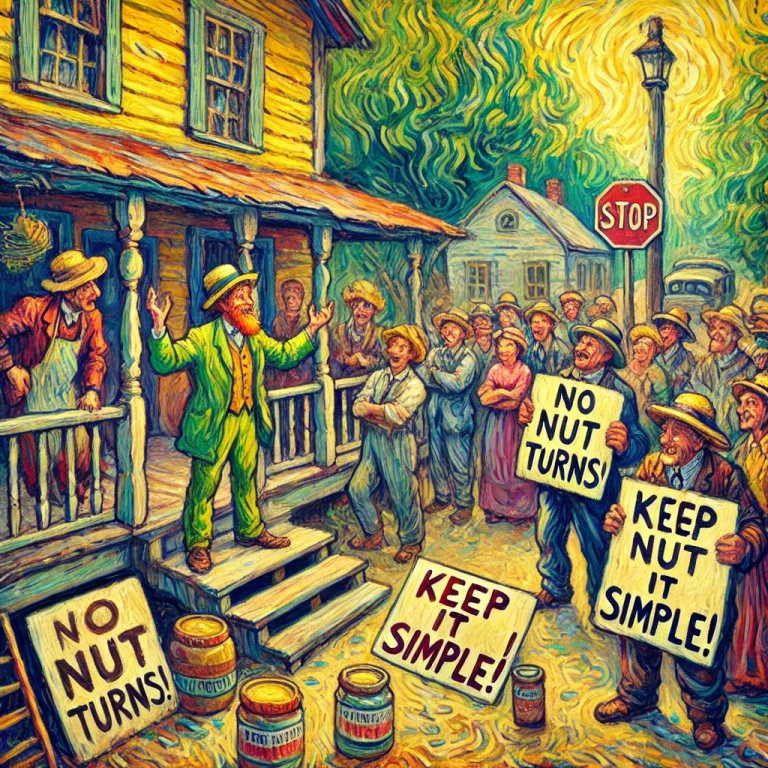
They Killed the Peanut Roundabout – The Protest Begins
Glossary Terms
They Killed the Peanut Roundabout – Glossary Of Terms
1. Peanut: A type of legume that grows underground, often consumed as a snack or used to produce peanut butter.
2. Roundabout: A circular intersection where traffic moves in one direction around a center island, allowing vehicles to merge smoothly.
3. Intersection: The point where two or more roads meet or cross each other.
4. Traffic: The movement of vehicles, pedestrians, and other forms of transport on roads.
5. Navigation: The process of planning and following a route or course, often using maps or GPS.
6. Signage: The use of signs to convey information, regulations, or directions to drivers and pedestrians.
7. Safety: The condition of being protected from harm or danger, especially in traffic situations.
8. Pedestrian: A person traveling on foot, especially in an urban area.
9. Vehicle: A machine used for transporting people or goods, including cars, buses, bicycles, and trucks.
10. Urban Planning: The process of designing and organizing city spaces and infrastructure.
11. Congestion: Overcrowding on roads that leads to slower movement of traffic.
12. Local Government: The administrative body governing a specific local area, responsible for public services and infrastructure.
13. Public Transport: A system of transport available to the general public, including buses, trains, and subways.
14. Traffic Calming: Measures implemented to reduce vehicle speeds and improve safety for pedestrians and cyclists.
15. Roundabout Design: The architecture and layout of a roundabout to optimize traffic flow and safety.
16. Accessibility: The degree to which people can easily reach and use transportation options.
17. Community Engagement: Involvement of local residents in the planning and decision-making processes regarding public spaces and infrastructure.
18. Road Maintenance: The process of keeping roads in good condition through repairs and upkeep.
19. Environmental Impact: The effect that a project or plan has on the surrounding ecosystem and community.
20. Traffic Flow: The movement of vehicles along a road network and how efficiently they can navigate it.
21. Infrastructure: The basic physical systems and structures that support the operation of a community or society.
22. Construction: The process of building or assembling infrastructure, often involving significant planning and resources.
23. Safety Protocols: Guidelines and practices established to ensure the safety of individuals during construction or traffic management.
24. Driver Behavior: The choices and actions of drivers while operating a vehicle on the road.
25. Emergency Services: Organizations that provide urgent response and assistance in emergencies, including accidents.
26. Road Sign: A sign installed along a road to convey information or regulations to drivers.
27. Capacity: The maximum amount of traffic a road or intersection can handle effectively.
28. Legislation: Laws and regulations governing transportation safety and infrastructure development.
29. Data Collection: The process of gathering information on traffic patterns and behaviors to inform planning and decision-making.
30. Community Impact: The effects that a transportation project or change has on the local population and their daily lives.
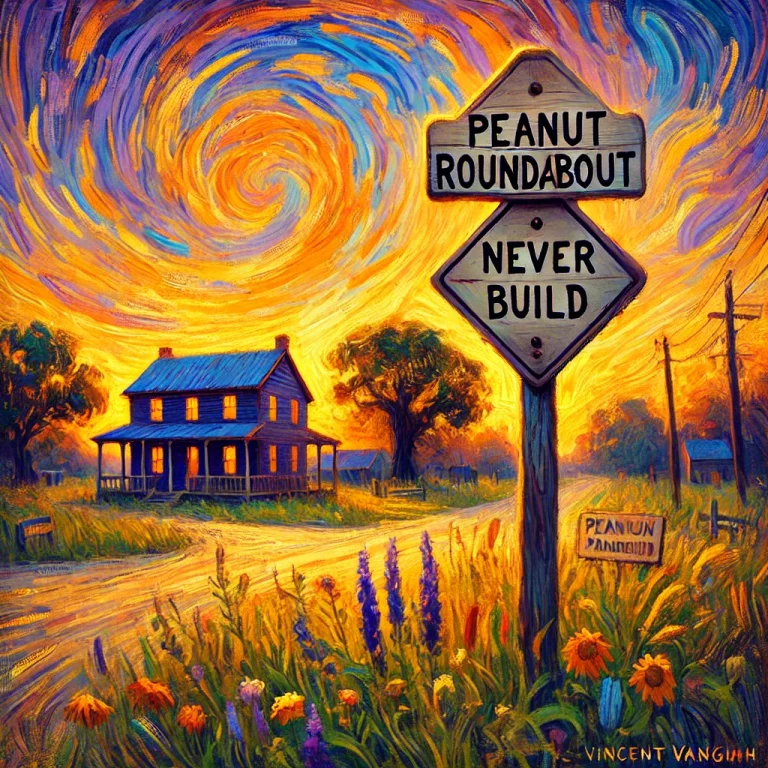
They Killed the Peanut Roundabout – Final Tribute – Memory Lives On
Song
They Killed the Peanut Roundabout – A Song
Creation Date – 13 Apr 2026, 9:16 AM
🎤 Song For This Story
[Verse 1]
In the town of Dunlap, folks were gleeful and spry,
A peanut-shaped roundabout, oh my, oh my!
State Highway 28 was ready for the show,
But locals gathered ’round, said, “Oh no, no, no!”
With hats in hand and wit so sly,
They mashed the state’s plans like a peanut pie.
Oh, peanut butter dreams turned to diesel fumes,
As visions of a roundabout fell into gloom.
[Chorus]
They killed the peanut roundabout, what a sight to see,
We mourn for our dreams of a nutty jubilee!
With squashed peanuts and jelly, we raise a toast,
RIP to the roundabout we loved the most.
They buried the banter, they crushed our delight,
In Dunlap, Tennessee, we’re losing our fight!
[Verse 2]
City planners chimed in, with their graphs and their schemes,
But this isn’t a thing you can measure in beams.
We needed a roundabout, surely that’s true,
But a peanut-shaped one? Who knew what to do!
They brought in their maps, their pencils, and tools,
While we flung out catchphrases like jelly-filled fools,
“We’ll send a letter to the governor soon!”
But we just wound up crackin’ up over our loon.
[Chorus]
They killed the peanut roundabout, what a sight to see,
We mourn for our dreams of a nutty jubilee!
With squashed peanuts and jelly, we raise a toast,
RIP to the roundabout we loved the most.
They buried the banter, they crushed our delight,
In Dunlap, Tennessee, we’re losing our fight!
[Bridge]
Now, festivals planned, with a peanut parade,
But without that roundabout, will it all fade?
The locals all laughed, saying, “We take a stand!”
With every shortcoming, we made our own brand.
Will the peanut rise up, in the future’s sweet air?
We’ll dream of that roundabout everywhere!
[Verse 3]
So here’s to the squashes, the butters, the bread,
And the dreams that we’ve carried where peanuts have led.
Let’s paint our forlorn with a smile instead,
For the peanut’s still here, in our hearts, it can tread.
So Dunlap will shine, let’s not lose our way,
Perhaps one sweet day, that roundabout will stay.
[Outro]
They killed the peanut roundabout, but we’ll keep the cheer,
Maybe one day it’ll be back, we’ll shed not a tear,
For now we remember, through laughter and glee,
The peanut we mourn, in our memories, free.
RIP – Peanut Roundabout 2026 – we never really got to know you.

They Killed the Peanut Roundabout – The Peanut Festival That Almost Was
At Dunlap Directory, we help Dunlap, Tennessee, business tell stories and market and sell their products and services.
Please share this post with your friends, family, or business associates who may want help telling the stories of their legacy.


